Author: Sujata

  • AI in Wealth Management: From Client Conversations to Execution

    AI in Wealth Management: From Client Conversations to Execution

    Wealth management has always been relationship-driven.

    But behind every client relationship is an enormous amount of operational work.

    Client meetings need to be documented. CRM records need to be updated. Follow-ups need to be tracked. Compliance documentation needs to be prepared. Portfolio discussions need to be summarized accurately. Internal coordination needs to happen across advisors, assistants, operations teams, and compliance stakeholders.

    Most advisory firms are not struggling because they lack expertise.

    They are struggling because execution has become fragmented.

    And this is exactly where AI in wealth management is starting to create real operational value.

    The conversation around artificial intelligence in financial services often focuses on predictions, robo-advisors, or automated investing. However, the real transformation is happening elsewhere.

    AI is increasingly becoming the operational layer that helps wealth advisors manage conversations, workflows, compliance, and client intelligence more efficiently.

    The shift is no longer about replacing advisors.

    It is about reducing operational friction so advisors can focus more on relationships, trust, and strategic decision-making.

    The Hidden Operational Burden Inside Wealth Management Firms

    Most wealth advisory firms run on conversations.

    Client meetings drive decisions. Reviews uncover opportunities. Portfolio discussions reveal concerns. Market updates trigger action items.

    But once the meeting ends, the real operational burden begins.

    Advisors often spend hours every week manually updating CRMs, writing summaries, preparing follow-up emails, documenting compliance notes, organizing client information, and coordinating across internal systems.

    In many firms, this process still depends heavily on memory and manual effort.

    A typical workflow often looks like this:

    • Conduct client meeting
    • Take scattered notes
    • Update CRM later
    • Draft follow-up manually
    • Prepare compliance documentation separately
    • Search across emails and files for context before the next meeting

    Over time, this creates operational inefficiencies that scale with the business.

    As advisory firms grow, the volume of conversations increases. More clients mean more meetings, more documentation, more coordination, and more compliance requirements.

    Without structured operational systems, advisors become buried under administrative overhead.

    This affects:

    • Client responsiveness
    • Data consistency
    • Compliance readiness
    • Advisor productivity
    • Internal coordination
    • Revenue opportunities

    The challenge is not the lack of information.

    The challenge is turning conversations into structured execution.

    Why Traditional Wealth Management Technology Still Creates Friction

    Most wealth management firms already use technology.

    They have CRMs, portfolio management systems, communication platforms, document repositories, and meeting tools.

    Yet operational friction still exists.

    Why?

    Because most tools were built to store information, not orchestrate workflows.

    Traditional CRMs require manual updates.
    Meeting platforms stop at recordings or transcripts.
    Compliance systems operate separately from client conversations.
    Knowledge remains fragmented across multiple tools.

    As a result, advisors still spend significant time:

    • Rewriting meeting notes
    • Searching for client context
    • Updating records manually
    • Coordinating follow-ups
    • Preparing audit-ready documentation

    Even modern AI note-taking tools often solve only a small part of the workflow.

    Generating a transcript is not the same as operational execution.

    Real operational intelligence requires systems that can understand conversations, structure insights, trigger workflows, and coordinate actions across the advisory lifecycle.

    This is where the next evolution of AI in wealth management is emerging.

    How AI Is Actually Being Used in Wealth Management

    The practical use of AI in wealth management is moving far beyond chatbots and generic automation.

    Advisory firms are increasingly using AI to streamline operational workflows and reduce administrative complexity.

    Meeting Intelligence

    Client meetings contain valuable information:

    • Financial goals
    • Risk concerns
    • Investment preferences
    • Family planning discussions
    • Compliance disclosures
    • Follow-up actions

    AI systems can now capture and structure these conversations automatically.

    Instead of relying on manual notes, advisors can generate:

    • Structured summaries
    • Action items
    • Client insights
    • Follow-up drafts
    • Meeting highlights
    • Decision logs

    This improves accuracy while reducing post-meeting workload.

    CRM Automation

    One of the largest operational pain points in advisory firms is CRM maintenance.

    Advisors often delay updates because documentation consumes time.

    AI can help automate:

    • Client interaction summaries
    • Relationship updates
    • Opportunity tracking
    • Follow-up reminders
    • Activity logging

    This helps maintain cleaner and more actionable client records.

    Compliance Documentation

    Compliance remains one of the most documentation-heavy areas of wealth management.

    Advisors need detailed records of:

    • Recommendations
    • Client communications
    • Disclosures
    • Risk acknowledgments
    • Suitability discussions

    AI systems can help generate structured compliance-ready documentation based on actual conversations and advisor-reviewed outputs.

    This reduces manual overhead while improving audit readiness.

    Pre-Meeting Intelligence

    Preparing for client meetings often requires reviewing:

    • Previous meeting notes
    • Portfolio updates
    • CRM records
    • Pending tasks
    • Market developments
    • Client history

    AI systems can consolidate this information into structured pre-meeting briefings.

    This allows advisors to enter meetings with better context and preparation.

    Workflow Automation

    Many advisory workflows still require repetitive manual coordination.

    Examples include:

    • Assigning follow-up tasks
    • Scheduling reviews
    • Sending recap emails
    • Updating internal systems
    • Managing approvals
    • Tracking open client actions

    AI-powered workflow systems can automate much of this operational coordination.

    The result is faster execution with less operational drag.

    The Rise of AI Agents in Wealth Management

    The next phase of AI in wealth management is not just AI assistants.

    It is AI agents.

    Traditional AI tools mainly respond to prompts.

    AI agents operate more like execution systems.

    Instead of simply generating outputs, they can:

    • Understand operational context
    • Coordinate workflows
    • Trigger actions
    • Structure information
    • Maintain continuity across tasks
    • Connect systems together

    This shift is particularly important for wealth management because advisory operations are deeply workflow-driven.

    A single client interaction may involve:

    • Meeting intelligence
    • CRM updates
    • Compliance documentation
    • Portfolio coordination
    • Internal approvals
    • Follow-up execution

    Managing this manually creates bottlenecks.

    AI agents help reduce this fragmentation.

    For example, a modern advisory workflow may include:

    Meeting Intelligence Agent

    Captures conversations and converts them into structured outputs such as summaries, action items, decisions, and CRM-ready updates.

    Meeting Prep Agent

    Prepares advisors before meetings using previous conversations, client records, portfolio context, and pending actions.

    Compliance Documentation Agent

    Supports advisor-reviewed documentation, audit trails, and structured compliance workflows.

    Together, these systems create a connected operational layer around advisory work.

    How SarvaX.ai Helps Wealth Advisory Firms Reduce Operational Overhead

    SarvaX.ai is designed to help organizations transform fragmented workflows into connected execution systems powered by AI agents.

    For wealth advisory firms, this means reducing the operational burden surrounding client conversations and internal coordination.

    Instead of treating meetings, CRM systems, compliance workflows, and follow-ups as disconnected processes, SarvaX.ai helps connect them into one operational layer.

    The platform supports workflows such as:

    • Real-time meeting intelligence
    • Structured meeting summaries
    • CRM-ready outputs
    • Advisor-approved compliance documentation
    • Follow-up coordination
    • AI-powered workflow execution
    • Enterprise search across conversations and documents
    • Cross-system operational intelligence

    The focus is not simply on transcription.

    The goal is operational execution.

    This helps advisory firms reduce time spent on repetitive administrative work while improving consistency and visibility across client operations.

    Why Security and Governance Matter in Financial AI

    AI adoption in financial services requires more than automation.

    It requires trust.

    Wealth management firms handle highly sensitive client information, including:

    • Financial records
    • Portfolio details
    • Family planning discussions
    • Tax considerations
    • Regulatory documentation

    As a result, security and governance are critical.

    Firms evaluating AI systems increasingly look for:

    • Secure infrastructure
    • Controlled data access
    • Audit-ready workflows
    • Human approval layers
    • Data privacy protections
    • Enterprise governance controls
    • Model flexibility

    This is especially important as firms move beyond isolated AI experiments and begin integrating AI into operational workflows.

    AI systems must support both productivity and governance simultaneously.

    The Future of Wealth Management Is AI-Augmented Execution

    The future of wealth management will not be defined by replacing advisors with AI.

    It will be defined by reducing operational friction around advisors.

    The firms that scale effectively over the next decade will likely be those that:

    • Capture operational intelligence more effectively
    • Reduce administrative overhead
    • Improve execution consistency
    • Maintain stronger compliance workflows
    • Create more connected advisor experiences

    AI is becoming the infrastructure layer that enables this shift.

    Not by replacing relationships.

    But by helping advisors spend less time managing fragmented workflows and more time serving clients strategically.

    This is where AI in wealth management is creating its most meaningful impact.

    FAQs

    How is AI used in wealth management?

    AI in wealth management is used for meeting intelligence, CRM automation, compliance documentation, workflow automation, portfolio insights, and operational coordination.

    Can AI automate CRM updates for financial advisors?

    Yes. Modern AI systems can generate CRM-ready summaries, track follow-ups, and structure client interaction data automatically.

    What are AI agents in wealth management?

    AI agents are systems designed to execute operational workflows, coordinate tasks, and structure information across advisory processes instead of simply responding to prompts.

    Can AI help with compliance documentation?

    Yes. AI can assist advisors by generating structured compliance-ready documentation based on meeting conversations and operational workflows.

    Is AI secure for financial advisory firms?

    Enterprise AI platforms increasingly include governance controls, secure deployment models, audit trails, approval workflows, and data privacy protections designed for regulated industries.

    Will AI replace wealth advisors?

    No. AI is more likely to augment advisory operations by reducing repetitive administrative work and improving workflow execution, allowing advisors to focus more on client relationships and strategic guidance.

    Final Thoughts

    AI in wealth management is no longer just about automation.

    It is becoming an operational execution layer for advisory firms.

    As client expectations grow and operational complexity increases, firms need systems that can transform conversations into structured workflows, actionable intelligence, and coordinated execution.

    Platforms like SarvaX.ai are helping advisory firms move beyond fragmented tools and toward AI-powered operational infrastructure built for modern wealth management.

  • The ROI of AI in Wealth Management Is Not Where Most Firms Think

    The ROI of AI in Wealth Management Is Not Where Most Firms Think

    Most wealth management firms are already experimenting with AI.

    Some are using AI to summarize meetings.
    Some are testing copilots internally.
    Others are automating small administrative tasks across operations.

    But very few firms are actually seeing meaningful ROI.

    Not because the technology is weak.

    Because most firms are applying AI to isolated tasks instead of improving how the business executes work across the client lifecycle.

    And that distinction matters more than people realize.

    The real value of AI in wealth management is not about generating notes faster or reducing a few manual clicks.

    It’s about reducing operational friction between conversations, decisions, follow-ups, compliance, and execution.

    That’s where the real ROI begins to appear.

    And when firms measure it properly, the impact usually shows up in three places:

    • time recovered
    • revenue protected and expanded
    • risk reduced

    Not independently.

    Together.

    Why ROI in Wealth Management Is Difficult to Measure

    ROI in wealth management rarely appears in obvious ways.

    Unlike transactional industries, advisory businesses operate through trust, timing, continuity, and relationships built over years.

    That means operational inefficiencies often remain invisible until they compound.

    A delayed follow-up may not seem serious today.
    A missing note may not look critical in the moment.
    An incomplete CRM update may feel manageable.

    But over time, those small gaps begin affecting:

    • client experience
    • relationship continuity
    • retention
    • upsell opportunities
    • operational visibility

    This is why many firms underestimate how much revenue and operational stability are quietly lost through fragmented workflows.

    The problem usually isn’t a lack of effort.

    It’s that too much execution still depends on memory, manual coordination, and disconnected systems.

    The First Layer of ROI: Recovering Advisor Time

    Most advisors spend a surprising amount of their week on work that does not directly create revenue.

    After every client interaction, there’s another operational cycle:
    rewriting notes, updating CRM systems, drafting follow-ups, organizing documentation, preparing compliance records, and trying to ensure nothing important gets missed.

    The meeting ends.

    Then the administrative workload begins again.

    Over time, this creates operational drag across the firm.

    Not because the tasks themselves are unnecessary.

    Because the workflows around them are fragmented.

    What Changes When Workflows Become Connected

    High-performing advisory firms are starting to treat meetings differently.

    They no longer see meetings as isolated conversations that need to be manually processed afterward.

    Instead, meetings become structured operational inputs.

    Client discussions automatically flow into:

    • summaries
    • action items
    • follow-ups
    • CRM updates
    • compliance records
    • workflow coordination

    The work continues from where the conversation ended.

    It does not restart manually afterward.

    That shift changes how advisors spend their time.

    Instead of constantly rebuilding context, teams spend more time on:

    • client relationships
    • strategic conversations
    • planning
    • growth

    This is where time ROI becomes meaningful.

    Not because firms save a few minutes.

    Because operational capacity expands without increasing organizational complexity.

    The Revenue Problem Most Firms Don’t See

    Revenue in wealth management is rarely lost in obvious ways.

    Most client meetings actually go well.

    The client is engaged.
    The conversation is productive.
    There are clear signals, concerns, priorities, and opportunities.

    And then execution slows down.

    Follow-ups get delayed.
    Next steps become unclear.
    Important context gets buried inside notes or scattered systems.

    Over time, opportunities disappear quietly.

    This is one of the biggest operational leaks inside advisory businesses.

    Not because advisors lack expertise.

    Because the systems connecting conversations to execution are weak.

    The Firms Growing Faster Operate Differently

    The best advisory firms do not rely heavily on memory and manual coordination after meetings.

    They operate through structured execution.

    Every conversation creates momentum.

    Decisions become actions.
    Actions become tracked workflows.
    Client context remains connected across systems.

    That changes how revenue moves through the organization.

    Instead of treating meetings as documentation exercises, firms begin treating them as execution triggers.

    The impact becomes visible quickly:

    • faster follow-ups
    • clearer ownership
    • better visibility
    • stronger client continuity
    • fewer missed opportunities

    Revenue becomes more predictable because execution becomes more consistent.

    And consistency compounds.

    The Most Underrated ROI Area: Risk Reduction

    This is where AI becomes strategically important for wealth management firms.

    Because operational risk in advisory businesses is deeply connected to documentation quality, visibility, and continuity.

    Many firms still rely on fragmented compliance processes:

    • scattered notes
    • inconsistent records
    • disconnected systems
    • manual audit preparation

    The issue is not that teams are careless.

    The issue is that operational history becomes difficult to maintain consistently at scale.

    And when firms grow, that complexity increases.

    What Happens When Compliance Becomes Continuous

    Structured AI systems fundamentally change this workflow.

    Instead of documentation becoming a separate process after the work is done, documentation becomes part of the workflow itself.

    Client interactions are captured automatically.
    Decisions remain connected to context.
    Records stay structured and searchable.
    Audit readiness becomes continuous instead of reactive.

    That changes the operational posture of the firm.

    Instead of scrambling during audits or compliance reviews, firms maintain visibility by default.

    The result is not just reduced compliance exposure.

    It’s stronger organizational trust.

    And in wealth management, trust is operational leverage.

    The Real ROI Comes From Compounding Effects

    Most firms evaluate AI as a collection of isolated efficiencies.

    But the real value appears when workflows become connected across the business.

    When advisors recover time, they spend more energy on clients.
    When follow-through improves, more opportunities convert.
    When visibility improves, compliance becomes easier to manage.
    When systems stay connected, execution becomes more reliable.

    Everything compounds together.

    This is why firms focused only on “AI tools” often fail to see transformational impact.

    The firms creating measurable ROI are building execution systems.

    Why Many AI Initiatives Fail

    A large number of firms adopt AI without changing how work actually flows through the organization.

    They implement:

    • note generators
    • isolated copilots
    • disconnected automations

    But the operational structure underneath remains fragmented.

    So the business experiences small efficiency gains without meaningful transformation.

    That’s why many AI implementations plateau quickly.

    Because AI alone does not fix execution fragmentation.

    Connected workflows do.

    The Shift Wealth Management Firms Are Now Making

    The firms seeing the strongest results are moving toward connected execution infrastructure.

    Meetings connect directly to workflows.
    Conversations trigger actions automatically.
    CRM systems update continuously.
    Compliance records remain structured in the background.

    Nothing depends entirely on memory anymore.

    And that changes how the organization operates at scale.

    Because once execution becomes structured, firms gain:

    • visibility
    • continuity
    • consistency
    • scalability
    • operational trust

    This is the real operational shift happening inside modern wealth management firms.

    Final Thought

    AI alone does not create ROI.

    Execution does.

    The firms that will outperform over the next few years will not necessarily be the firms using the most AI tools.

    They will be the firms that:

    • capture every client interaction properly
    • maintain continuity across workflows
    • turn conversations into actions immediately
    • reduce operational leakage
    • stay compliant without slowing execution down

    Because in wealth management, growth is rarely limited by intelligence.

    It is usually limited by execution consistency.

    And the firms that solve that problem first will compound faster than everyone else.

    SarvaX.ai helps wealth advisory firms turn client conversations into structured execution systems.

    From follow-ups and CRM coordination to workflow automation and compliance-ready documentation, SarvaX.ai connects conversations to outcomes automatically.

    So meetings no longer end as scattered notes.

    They continue as execution.

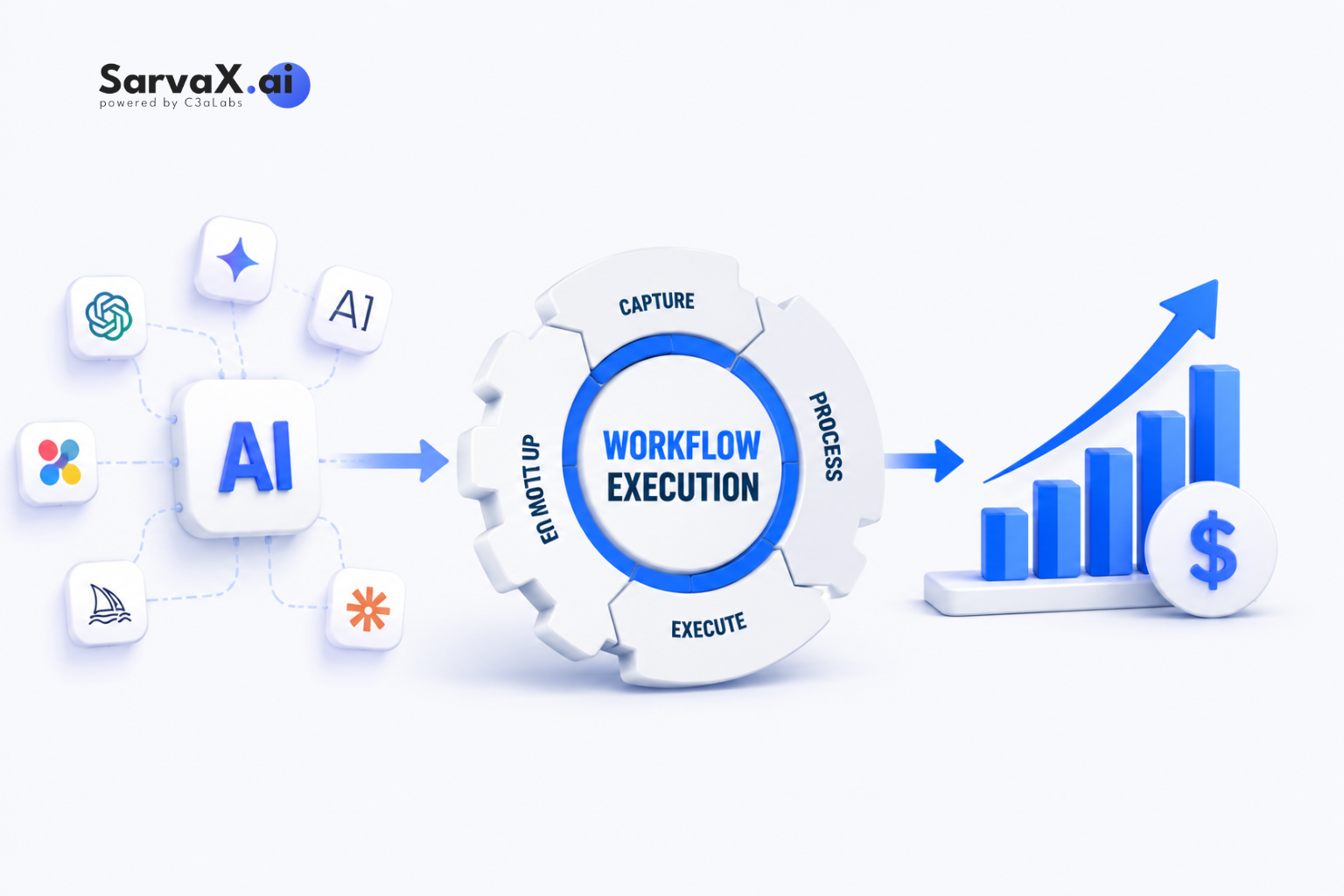
  • AI Integration Is Not About AI Tools. It’s About Workflow Execution

    AI Integration Is Not About AI Tools. It’s About Workflow Execution

    Most businesses already use AI in some form.

    Teams generate content with it.
    Summarize meetings with it.
    Research faster with it.
    Draft emails, reports, and responses with it.

    And for a while, that feels productive.

    But eventually, a different problem starts appearing.

    The AI generates the output.
    Then someone still has to move the work forward manually.

    Copy the response.
    Paste it into another system.
    Update the CRM.
    Send the follow-up.
    Create the task.
    Notify the team.

    The thinking becomes faster.
    The execution does not.

    This is where most businesses hit the real limitation of AI adoption.

    Not because the models are weak.

    Because the workflows around them are still fragmented.

    And that’s exactly what AI integration is meant to solve.

    AI integration is not about adding another AI feature into your stack.

    It’s about connecting AI directly into the flow of work so execution happens continuously instead of manually.

    That’s the real shift.

    Why Most AI Usage Breaks at the Workflow Level

    Most teams are not actually operating AI systems.

    They are operating disconnected AI moments.

    A prompt here.
    A response there.
    A manual handoff afterward.

    At first, the friction feels small.

    But once AI usage becomes part of daily operations, the inefficiencies compound quickly.

    Teams begin spending time:

    • switching between tools
    • rewriting context
    • manually coordinating actions
    • repeating workflows
    • transferring outputs between systems

    The result is operational fragmentation disguised as productivity.

    AI helps teams think faster.

    But the business still executes manually.

    That creates what many organizations are now experiencing internally:
    an execution gap between AI outputs and real operational movement.

    And the larger the organization becomes, the more expensive that gap gets.

    What AI Integration Actually Changes

    AI integration changes where AI exists inside the workflow.

    Instead of AI sitting outside the business waiting for prompts, it becomes connected directly to operational systems.

    That means workflows begin responding automatically to real business events.

    A meeting ends.
    The system generates structured notes, follow-ups, tasks, and CRM updates automatically.

    A support ticket arrives.
    The workflow classifies urgency, drafts a response, updates records, and routes the request instantly.

    A new lead enters the pipeline.
    The system enriches context, qualifies the lead, triggers actions, and alerts the right teams.

    The important shift is this:

    The work no longer depends entirely on someone manually moving information between systems.

    Execution becomes connected.

    The Real Problem Businesses Are Facing

    Most businesses do not have an AI problem.

    They have a workflow coordination problem.

    The systems inside the organization are disconnected:

    • CRM in one place
    • meetings in another
    • tasks elsewhere
    • communication scattered
    • approvals fragmented
    • operational visibility limited

    So even when AI produces useful outputs, the organization still struggles to operationalize them consistently.

    That’s why many companies feel disappointed after initial AI adoption.

    The outputs improve.

    But the operational structure underneath stays the same.

    AI Integration Is Really About Workflow Continuity

    The most important thing AI integration creates is continuity.

    Without integration, workflows constantly break between steps.

    Someone has to:

    • remember context
    • trigger actions manually
    • coordinate systems
    • update records
    • maintain operational flow

    That creates invisible operational drag.

    AI integration reduces that friction by ensuring work continues automatically after an event occurs.

    The workflow keeps moving.

    Not because people are constantly coordinating it manually.

    Because the systems themselves are connected.

    How AI Integration Actually Works

    At a technical level, AI integration follows a structured operational flow.

    Every workflow begins with a trigger.

    A new customer inquiry.
    A completed meeting.
    A support request.
    A file upload.
    A status update.

    That event activates the workflow automatically.

    From there, the system prepares the necessary context:
    customer history, CRM data, metadata, previous interactions, internal rules.

    Then the workflow routes the task to the appropriate AI model.

    This is important because different workflows require different capabilities.

    Some tasks require:

    • reasoning
    • structured extraction
    • speed
    • classification
    • summarization
    • compliance handling

    The workflow then converts AI outputs into structured operational objects:

    • CRM entries
    • tasks
    • reports
    • workflow updates
    • approvals
    • notifications

    Finally, the system executes actions automatically across connected tools.

    The important thing is not the AI responsew itself.

    It’s that the workflow continues operationally after the response is generated.

    Why AI Integration Is Different from Using AI Tools

    Most AI tools still operate in isolation.

    They assist with:

    • writing
    • brainstorming
    • summarization
    • research

    But they stop before execution.

    AI integration goes further.

    It connects AI directly into operational systems so that:

    • workflows continue automatically
    • systems stay synchronized
    • outputs become actionable
    • execution becomes observable
    • coordination becomes scalable

    This changes the role of AI inside the organization.

    From:
    AI helping individuals perform tasks

    To:
    AI helping the organization execute workflows continuously

    That’s a completely different operating model.

    Where AI Integration Creates The Most Value

    AI integration works best in environments with repetitive operational workflows.

    Especially where teams constantly move information between systems.

    Customer support is one example.

    Requests arrive continuously.
    Context must remain connected.
    Responses need coordination.
    Systems require updates.

    Without integration, teams manually manage each step.

    With integration, workflows maintain continuity automatically.

    The same pattern appears across:

    • sales operations
    • internal coordination
    • reporting workflows
    • onboarding
    • compliance processes
    • meeting execution
    • project management

    The bigger the workflow volume becomes, the more valuable integration becomes.

    Because operational consistency begins scaling with the business.

    Why AI Orchestration Matters

    As workflows grow, organizations eventually realize a single AI model is not enough.

    Different tasks require different strengths.

    Some models perform better at reasoning.
    Others are faster.
    Others handle structured outputs more reliably.

    This is where orchestration becomes important.

    AI orchestration acts as the coordination layer between:

    • workflows
    • business rules
    • AI models
    • operational systems

    Instead of treating AI as one assistant, organizations begin treating it as an execution infrastructure layer composed of specialized systems.

    That’s how enterprise AI begins scaling properly.

    Why Many AI Integration Projects Fail

    Most AI integration failures happen because companies approach automation too aggressively too early.

    They try to automate entire organizations immediately.

    But successful integration usually starts much smaller.

    One workflow.
    One operational problem.
    One repeatable process.

    The companies that succeed focus first on:

    • workflow clarity
    • structured inputs
    • operational visibility
    • governance
    • execution reliability

    Because without structure, automation simply scales chaos faster.

    The Companies Winning with AI Are Building Execution Systems

    The businesses seeing the strongest AI outcomes are not just deploying tools.

    They are redesigning how operational work flows through the company.

    Meetings connect to tasks.
    Tasks connect to approvals.
    Approvals connect to systems.
    Systems maintain continuity automatically.

    The result is not just efficiency.

    It’s operational coherence.

    And that’s where AI starts becoming infrastructure instead of software.

    Final Thought

    AI integration is not really about prompts.

    It’s about execution.

    If teams are still manually moving outputs between systems, coordinating workflows through memory, and constantly rebuilding context, then AI is only solving a fraction of the problem.

    The real value appears when AI becomes connected directly into operational workflows.

    When systems trigger actions automatically.
    When workflows maintain continuity.
    When execution happens without constant coordination overhead.

    That’s the shift from isolated AI usage to operational AI infrastructure.

    And that’s what AI integration actually makes possible.

    SarvaX.ai helps businesses connect AI directly into operational workflows across meetings, CRM systems, tasks, approvals, and business execution.

    Instead of using AI in fragments, teams can build connected systems where conversations, workflows, and actions move together automatically.

    So AI no longer stays isolated inside prompts.

    It becomes part of how the business executes work every day.

  • How Wealth Advisors Can Save 10+ Hours a Week Using AI

    How Wealth Advisors Can Save 10+ Hours a Week Using AI

    Most wealth advisors are not losing time because they lack expertise.

    They’re losing time because too much of their day is spent on operational work that happens around client relationships.

    Meeting notes. CRM updates. Follow-ups. Compliance documentation. Client prep. Internal coordination.

    None of these tasks directly generate revenue. But they consume hours every single week.

    And this creates a dangerous cycle.

    The more time advisors spend on admin work, the less time they spend where real value is created:

    • client conversations
    • relationship building
    • strategic advice
    • revenue-generating activity

    This is exactly why AI is becoming one of the biggest operational shifts in wealth management.

    Not because it replaces advisors.

    But because it removes the invisible workload slowing them down.

    Where Wealth Advisors Actually Spend Their Time

    Most firms underestimate how much operational drag exists inside daily workflows.

    A typical advisor’s week includes:

    • Preparing for meetings
    • Reviewing client history
    • Writing meeting summaries
    • Updating CRM systems
    • Drafting follow-up emails
    • Managing tasks and reminders
    • Organizing compliance records

    Individually, these tasks feel small.

    But combined, they consume enormous amounts of time.

    In many firms, advisors spend:

    • 1–2 hours daily on administrative work
    • 5–10 hours weekly on post-meeting workflows alone
    • Additional hours preparing for upcoming client meetings

    Over time, this becomes unsustainable.

    Because growth creates more clients, but also more operational overhead.

    The Real Cost of Manual Work

    The problem isn’t just time.

    It’s what that lost time prevents advisors from doing.

    When operational work increases:

    • client responsiveness slows down
    • follow-ups become inconsistent
    • preparation quality drops
    • opportunities get missed

    And eventually, the client experience suffers.

    This is where AI creates real value.

    Not by making advisors work harder.

    But by removing the repetitive work that drains momentum from the business.

    How AI Saves Wealth Advisors 10+ Hours Per Week

    The biggest gains happen when AI is connected across the full advisory workflow.

    Let’s break it down.

    1. Automatic Meeting Summaries and Notes

    One of the biggest time drains in wealth management happens after client meetings.

    Most advisors still spend time:

    • writing summaries manually
    • organizing notes
    • documenting decisions
    • tracking next steps

    This process is repetitive and inconsistent.

    AI changes this completely.

    Instead of manually documenting every conversation, the system automatically generates:

    • structured meeting summaries
    • action items
    • client decision logs
    • follow-up recommendations

    What used to take 20–30 minutes per meeting now happens instantly.

    For advisors running multiple meetings daily, this alone can save several hours every week.

    2. CRM Updates Without Manual Data Entry

    CRM systems are critical for advisory firms.

    But manual CRM updates are one of the most frustrating parts of the job.

    Advisors often delay updates because:

    • they’re repetitive
    • time-consuming
    • difficult to maintain consistently

    As a result, CRM data becomes incomplete or outdated.

    AI solves this by converting conversations directly into structured CRM updates.

    Instead of manually entering:

    • meeting details
    • client concerns
    • next steps
    • portfolio discussions

    The system updates records automatically.

    This reduces administrative workload significantly while improving data accuracy across the firm.

    3. Faster Follow-Ups and Client Communication

    Follow-ups are essential in wealth management.

    But drafting personalized communication after every meeting takes time.

    AI can automatically generate:

    • follow-up emails
    • review summaries
    • client recaps
    • task reminders

    The advisor simply reviews and approves.

    This dramatically reduces communication time while improving responsiveness.

    And in relationship-driven businesses, responsiveness directly impacts trust and retention.

    4. Smarter Client Meeting Preparation

    Preparation is another major hidden workload.

    Before every client meeting, advisors often need to:

    • review CRM history
    • check portfolio performance
    • revisit previous conversations
    • gather documents and notes

    This process can easily consume 30–60 minutes per meeting.

    AI-powered meeting preparation systems reduce this to minutes by automatically generating briefing packs that include:

    • client history
    • previous meeting context
    • portfolio insights
    • risk indicators
    • suggested talking points

    Instead of searching across disconnected systems, advisors enter meetings fully prepared instantly.

    5. Reduced Compliance Documentation Work

    Compliance documentation is necessary, but extremely time-consuming.

    Manual processes create:

    • duplicated work
    • inconsistent records
    • audit stress

    AI helps automate compliance workflows by:

    • generating audit-ready summaries
    • maintaining structured interaction logs
    • tracking disclosures and decisions

    This reduces back-office workload while improving operational consistency.

    More importantly, it reduces the risk of missing critical documentation.

    The Compounding Effect of Time Savings

    Saving 10 hours per week is not just about efficiency.

    It changes how advisory firms operate.

    Let’s look at the bigger picture.

    More Time for Revenue-Generating Work

    When advisors spend less time on admin:

    • they can handle more client relationships
    • improve responsiveness
    • increase meeting quality
    • focus on growth initiatives

    This creates direct business impact.

    Better Client Experience

    Clients notice:

    • faster communication
    • stronger follow-ups
    • better preparedness

    This improves trust, retention, and long-term relationship value.

    Reduced Team Burnout

    Operational overload is one of the biggest causes of advisor fatigue.

    AI reduces repetitive work and allows teams to focus on higher-value tasks instead of constant administrative execution.

    Improved Operational Scalability

    Without automation, growth creates operational chaos.

    With AI-driven workflows:

    • processes become standardized
    • execution becomes consistent
    • firms scale without dramatically increasing overhead

    Why Most Firms Still Struggle to Save Time

    Many firms adopt AI tools but see limited impact.

    Why?

    Because they automate isolated tasks instead of fixing workflow structure.

    For example:

    • using AI only for transcription
    • disconnected CRM systems
    • no workflow automation
    • manual approvals everywhere

    The result is fragmented efficiency.

    Not transformation.

    The Future of Wealth Management Operations

    The next generation of advisory firms will not operate through disconnected systems and manual coordination.

    They will operate through:

    • connected workflows
    • structured client intelligence
    • automated execution systems

    Where:

    • meetings trigger actions
    • actions update systems
    • systems maintain records automatically

    This is where the biggest productivity gains will come from over the next few years.

    Final Thought

    The goal of AI in wealth management is not to replace advisors.

    It’s to remove the operational friction slowing them down.

    Because advisors create value through:

    • relationships
    • trust
    • strategic thinking

    Not repetitive admin work.

    The firms that win will be the ones that free advisors to focus on what actually matters while the system handles the operational layer in the background.

    And when that happens, saving 10+ hours per week becomes just the beginning.

    If your advisory team is spending hours every week on notes, CRM updates, follow-ups, and compliance documentation, the problem is not your people.

    It’s the workflow.

    SarvaX.ai helps wealth advisory firms automate post-meeting execution, CRM updates, follow-ups, and compliance workflows so advisors can focus on clients instead of admin work.

    Explore how SarvaX.ai can help your firm save time, improve execution, and scale efficiently.

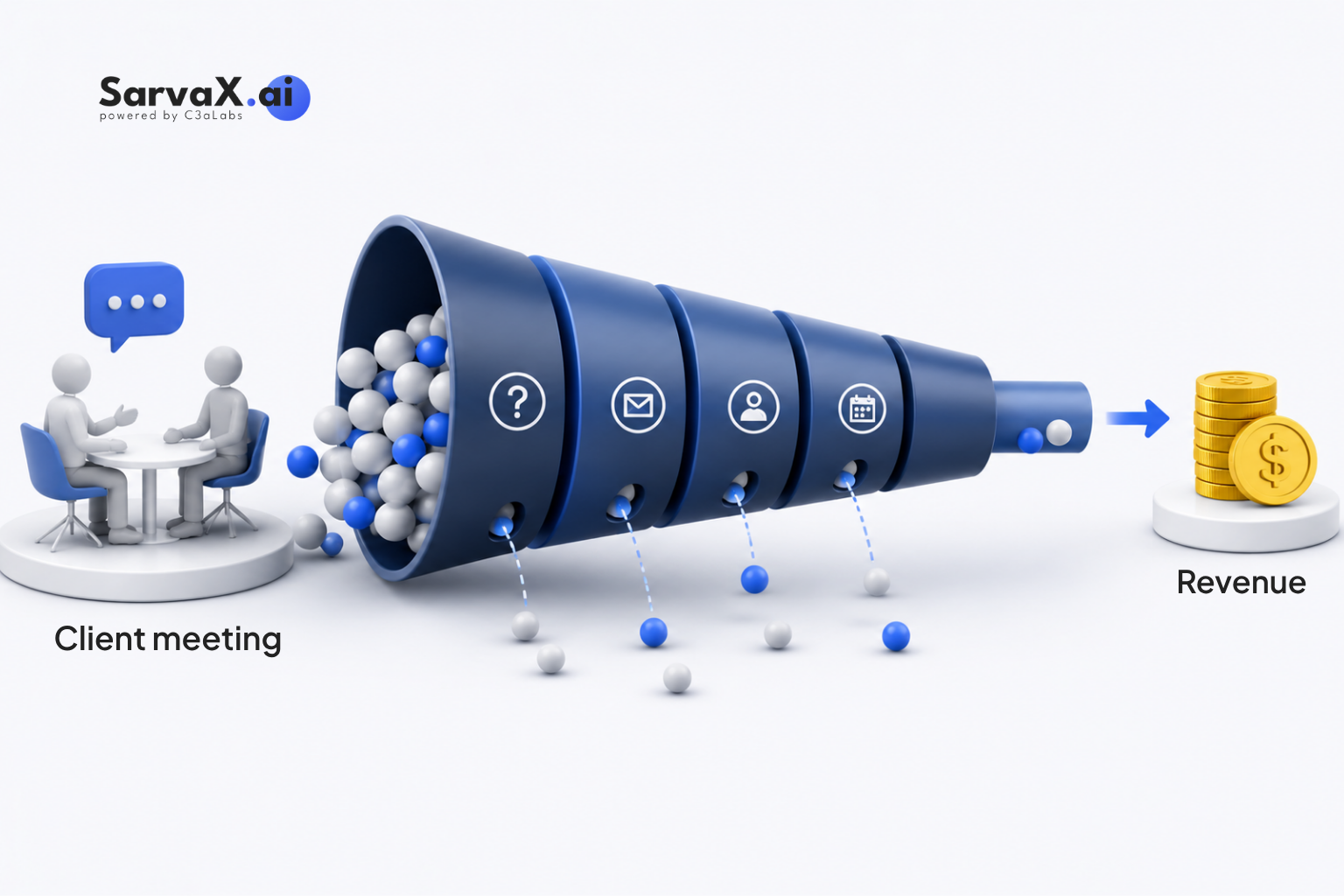
  • Why Most Client Meetings Never Turn Into Revenue

    Why Most Client Meetings Never Turn Into Revenue

    Why Most Client Meetings Never Turn Into Revenue

    Most client meetings feel productive in the moment.

    The client is engaged. The conversation flows well. There are clear signals, intent, and sometimes even buying interest.

    And then nothing happens.

    Follow-ups get delayed. Notes are incomplete. CRM updates are missed. Important details fade.

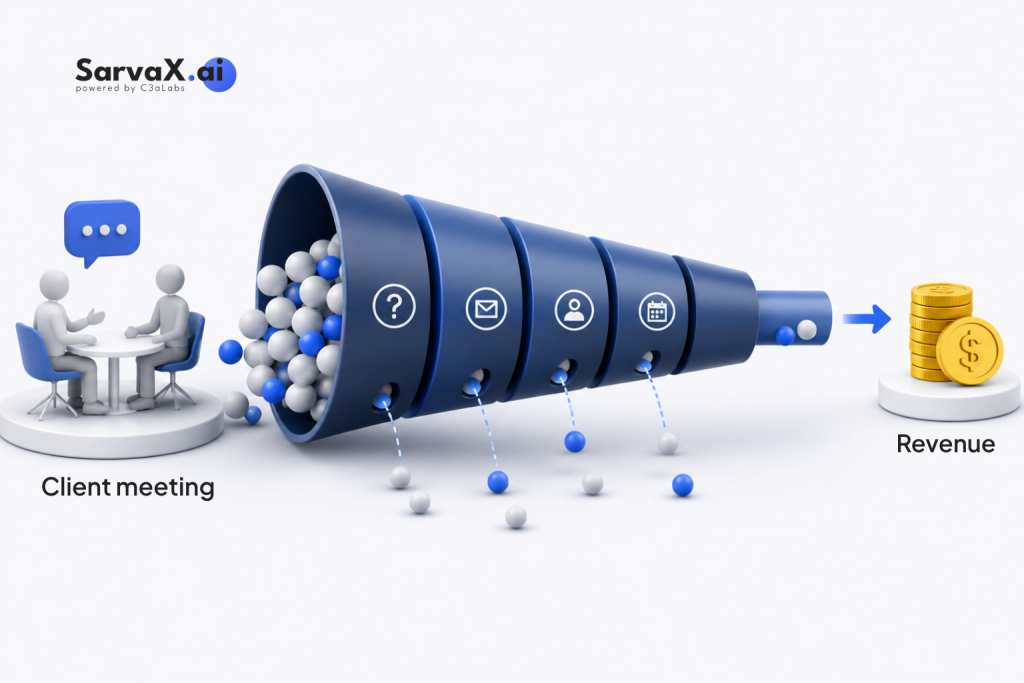
    This is where most revenue is actually lost not before the meeting, but after it.

    The real problem after client meetings

    The issue is not the meeting itself.

    It’s what happens once the meeting ends.

    Most advisory workflows look like this:

    • Notes are written loosely or not at all
    • Follow-ups depend on memory
    • CRM updates are pushed to “later”
    • Action items are not clearly defined
    • Client intent gets lost in scattered information

    So even when a meeting creates opportunity, it doesn’t turn into execution.

    And if there’s no execution, there’s no revenue.

    Why this keeps happening

    It’s not a skill problem.

    It’s a system problem.

    Most advisors are working with disconnected tools:

    • One place for notes
    • Another for CRM
    • Another for tasks
    • Another for communication

    Nothing is connected.

    So after every meeting, you’re basically doing the same work again:

    • Recalling what was said
    • Rewriting context
    • Figuring out next steps
    • Trying not to miss follow-ups

    This slows everything down and increases the chances of things slipping.

    What gets lost between meetings and execution

    A lot more than people realize:

    • Follow-ups that should have been sent
    • Client intent signals that were never captured properly
    • Opportunities that were discussed but not tracked
    • Action items that were never assigned
    • Context that disappears after a few hours

    Each of these seems small.

    But together, they create a steady leak in revenue.

    The shift: from conversations to execution

    High-performing advisory teams don’t treat meetings as isolated events.

    They treat them as the starting point of execution.

    That means:

    • Conversations don’t end in notes
    • They end in actions
    • Follow-ups
    • Decisions
    • Updated systems

    The meeting is not the output.

    Execution is.

    What needs to change in the workflow

    1. Capture every meeting properly

    If a meeting isn’t captured clearly, everything after it breaks.

    Key points, intent, objections, and decisions need to be recorded in a structured way — not just scattered notes.

    2. Turn conversations into actions immediately

    Every meeting should produce clear next steps:

    • Follow-ups
    • Tasks
    • Deadlines
    • Ownership

    If actions are not created immediately, they get lost.

    3. Keep CRM updated without manual effort

    CRM should not depend on discipline.

    It should reflect what actually happened in the meeting automatically and consistently.

    4. Follow-ups should not depend on memory

    Follow-ups are where deals are won or lost.

    They should be:

    • Immediate
    • Context-aware
    • Based on real conversation points

    Not delayed or generic messages sent later.

    5. Make execution continuous, not manual

    Work should not restart after every meeting.

    It should continue from where the conversation ended.

    What changes when this is fixed

    When client conversations are properly connected to execution:

    • Follow-ups stop getting missed
    • Deals don’t go cold unnecessarily
    • Advisors save hours every week
    • Client experience becomes consistent
    • Revenue becomes more predictable

    The work doesn’t increase.

    It becomes more structured.

    Final thought

    Client meetings don’t create revenue by themselves.

    Execution does.

    If conversations are not turning into actions, then value is being lost every single day without visibility.

    The difference between a good advisor and a growing advisory business is not better conversations.

    It’s what happens after them.

    SarvaX.ai helps advisory teams turn client conversations into structured actions, follow-ups, CRM updates, and compliance-ready documentation — without manual effort.

    So every meeting leads to execution, not lost opportunity.

  • The Hidden Cost of Manual CRM Updates in Wealth Management

    The Hidden Cost of Manual CRM Updates in Wealth Management

    How Wealth Advisors Can Save 10+ Hours a Week Using AI

    Most wealth advisory firms already have a CRM.

    But having a CRM and having reliable client intelligence are two completely different things.

    Because here’s the uncomfortable reality:

    In many firms, the CRM only reflects what advisors remembered to update.

    Not what actually happened.

    That creates a massive operational blind spot.

    Client conversations happen daily. Important signals are discussed. Decisions are made. Opportunities emerge.

    But when CRM updates are manual, much of that information never makes it into the system accurately.

    And over time, this creates something far more dangerous than inefficiency:

    • inconsistent client data
    • poor decision-making
    • missed revenue opportunities
    • increased compliance risk

    The problem isn’t the CRM itself.

    The problem is the workflow around it.

    Why Manual CRM Updates Break Wealth Management Operations

    Wealth management is deeply relationship-driven.

    Every interaction matters:

    • client concerns
    • portfolio discussions
    • risk tolerance changes
    • life events
    • follow-up commitments

    But most firms still rely on advisors to manually document all of this after meetings.

    That sounds manageable in theory.

    In reality, it rarely works consistently.

    What Actually Happens After Most Client Meetings

    A typical advisor finishes a meeting and immediately moves to the next task.

    The CRM update becomes something they plan to complete “later.”

    When that happens:

    • details get forgotten
    • notes become simplified
    • context disappears
    • updates are delayed or skipped entirely

    Over time, CRM records become fragmented.

    Some clients have detailed histories. Others have partial updates. Some interactions never get logged at all.

    The result is a system full of incomplete truth.

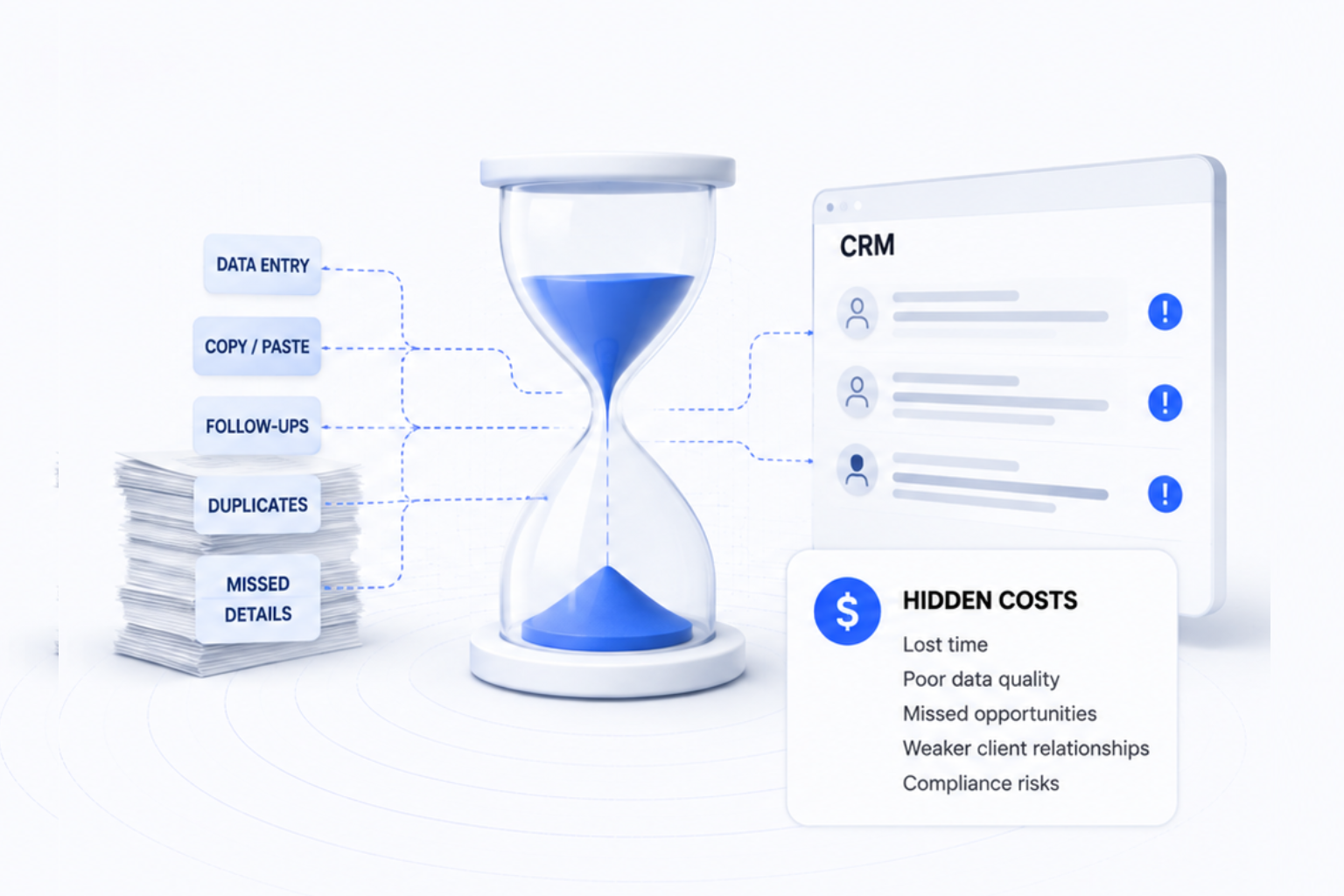
    The Hidden Cost Most Firms Don’t Measure

    The damage from manual CRM updates is not always obvious immediately.

    That’s why many firms ignore it.

    But the long-term impact is significant.

    1. Inconsistent Data Leads to Poor Decisions

    Advisors and leadership teams rely on CRM systems to understand:

    • client relationships
    • opportunities
    • pipeline health
    • engagement patterns

    But if the underlying data is incomplete, every decision becomes weaker.

    For example:

    • opportunities may appear inactive when client interest actually exists
    • important risk discussions may never be recorded
    • advisors may miss changes in client goals or priorities

    This creates operational confusion across the business.

    And in wealth management, small gaps in context can lead to major consequences.

    2. Revenue Opportunities Quietly Disappear

    This is one of the biggest hidden problems.

    Most lost revenue in advisory firms does not come from bad advice.

    It comes from:

    • delayed follow-ups
    • forgotten commitments
    • missed signals
    • inconsistent execution

    When CRM updates are manual:

    • next steps are not clearly tracked
    • opportunities are not surfaced properly
    • follow-up timing becomes inconsistent

    Over time, firms lose momentum with clients.

    And when momentum drops, conversion rates and retention suffer.

    3. Advisors Spend Too Much Time on Administrative Work

    Manual CRM updates are also a major productivity drain.

    Many advisors spend hours every week:

    • writing summaries
    • organizing notes
    • updating records
    • logging activities

    This creates operational fatigue.

    More importantly, it shifts advisor time away from:

    • relationship building
    • strategic discussions
    • revenue-generating conversations

    Instead of focusing on clients, advisors become data-entry operators.

    4. Compliance Risks Increase

    Wealth management firms operate in a highly regulated environment.

    That means documentation matters.

    When CRM updates are inconsistent:

    • interaction history becomes incomplete
    • disclosures may not be tracked properly
    • audit trails become fragmented

    This creates significant compliance exposure.

    And during audits, firms often realize too late that critical information was never documented correctly.

    The risk here is not just operational.

    It’s reputational and regulatory.

    Why Traditional CRM Systems Cannot Solve This Alone

    Most CRM platforms were built to store information.

    Not capture it.

    They depend heavily on:

    • manual entry
    • advisor discipline
    • repetitive workflows

    That’s the core limitation.

    The CRM only becomes as good as the effort required to maintain it.

    And in fast-moving advisory environments, manual maintenance breaks down quickly.

    The Shift: From Manual Entry to Automated Intelligence

    This is where AI changes the operating model completely.

    Instead of asking advisors to manually feed systems after meetings, AI captures information directly from real interactions.

    That means:

    • meetings become structured records automatically
    • decisions are extracted instantly
    • action items are tracked immediately
    • CRM updates happen without manual effort

    This changes CRM from a passive database into a live operational system.

    What AI-Driven CRM Automation Looks Like

    A connected workflow typically works like this

    During the Meeting

    The system captures:

    • conversation context
    • speaker identification
    • client intent signals
    • decisions and commitments

    After the Meeting

    AI automatically generates:

    • structured meeting summaries
    • CRM-ready updates
    • follow-up drafts
    • task assignments

    Across the Workflow

    The system maintains:

    • interaction timelines
    • compliance-ready documentation
    • relationship intelligence
    • opportunity tracking

    Instead of fragmented data, firms now operate with a complete and consistent view of client relationships.

    The Business Impact of CRM Automation

    The impact goes far beyond efficiency.

    Better Decision-Making

    Leadership and advisors work with cleaner, more reliable data.

    This improves:

    • relationship management
    • pipeline visibility
    • forecasting accuracy
    • operational consistency

    Faster Execution

    Nothing gets delayed waiting for manual updates.

    Follow-ups happen faster. Opportunities move quicker. Client responsiveness improves.

    Increased Revenue Retention

    When conversations are captured properly:

    • fewer opportunities are missed
    • clients feel more understood
    • relationships become stronger

    This directly impacts retention and growth

    Reduced Operational Stress

    Advisors spend less time on repetitive admin work and more time on meaningful client engagement.

    This improves both productivity and team efficiency.

    The Future of Wealth Management Operations

    The next generation of advisory firms will not rely on manual coordination to maintain client intelligence.

    They will operate through connected systems where:

    • conversations automatically create records
    • records automatically trigger actions
    • actions automatically update workflows

    This is where the industry is moving.

    Because firms are realizing something important:

    Client relationships move too fast for manual systems to keep up.

    Final Thought

    Most wealth advisory firms believe their CRM is their source of truth.

    But if updates depend on manual effort, the system will always contain gaps.

    And gaps create:

    • missed opportunities
    • poor decisions
    • operational inefficiency
    • compliance risk

    The real opportunity is not just improving CRM usage.

    It’s eliminating the manual workflow entirely.

    Because in modern wealth management:

    The firms that capture client intelligence fastest will execute fastest.
    And the firms that execute fastest will win.

    If your advisory team still relies on manual CRM updates after client meetings, you’re operating with incomplete intelligence.

    SarvaX.ai helps wealth management firms automatically convert client conversations into structured CRM updates, follow-ups, action items, and compliance-ready records.

    Explore how SarvaX.ai can help your firm reduce operational friction, improve data quality, and protect revenue opportunities.